The software

Seven things
you stop guessing.

HULO reads the sensors, models and operational context a utility already owns, and turns them into one live understanding of the network. Below is what that actually gets you, described as work rather than as features.

No new hardware.

Every capability on this page runs on the instrumentation you already have. If your network is too sparsely instrumented for a given claim, we tell you that in the feasibility scan, before you sign, not after.

This is it

Not a dot on a map.
A leak on a street.

Most leak software hands you a coordinate and wishes you luck. HULO renders the network itself: the mains, the valve that isolates this section, and the point where the hydraulics stop agreeing with the model.
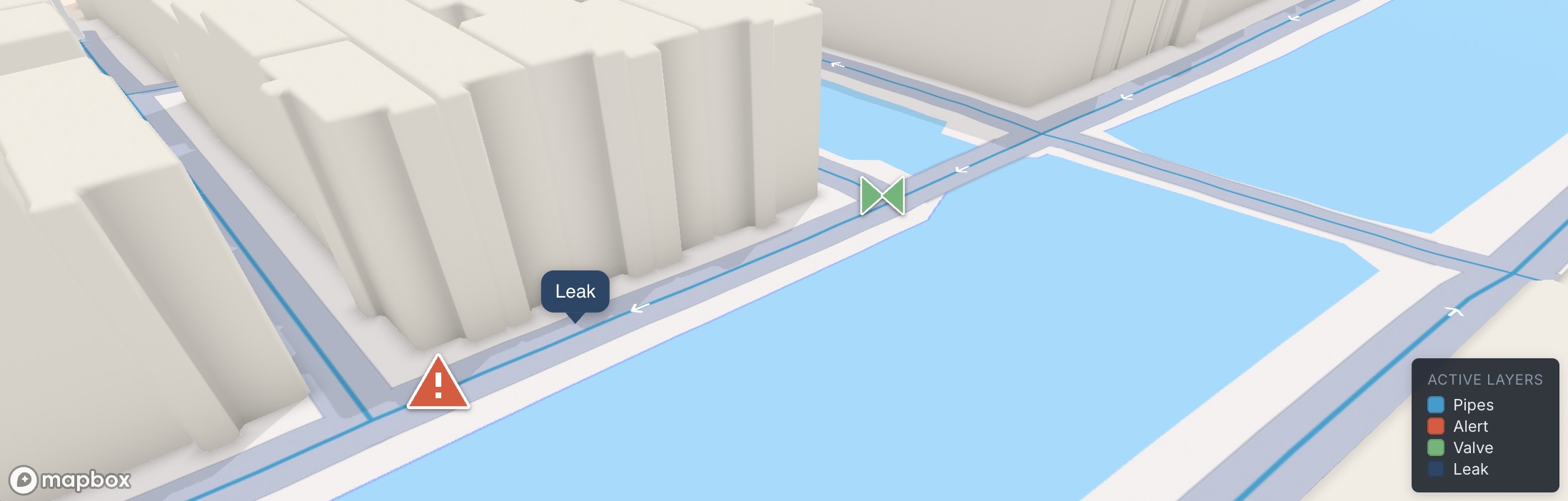
HULO over a 3D city map: the mains drawn in blue along the streets and under a canal, a leak marked on one of them, an alert on the same run, the valve that isolates it, and a legend naming the active layers.
ILLUSTRATION · DETECTED LEAK, THE MAIN IT SITS ON, AND THE VALVE THAT ISOLATES IT
HOW TIGHT THE AREA IS ON YOUR NETWORK DEPENDS ON YOUR INSTRUMENTATION. THE FEASIBILITY SCAN SAYS WHICH.
The mains, not a basemapYour actual pipe network, drawn from your own model and coloured by what it is doing right now.
The valve that mattersThe asset a crew would actually turn. Simulate closing it and see which streets lose supply before anyone drives out.
The leak, with its reasoningNot a coordinate. A location, an estimated loss rate, and the evidence that led to it, one click away.

01

One live picture of the network

Pipes, pumps, valves, tanks and sensors on one map, in their real positions, coloured by what they are doing right now. Not a dashboard of charts, the network itself. You can move through time: back into history, and roughly a day ahead.

  • Zone focus that promotes rather than filters, so a cross-boundary incident is never hidden
  • Healthy sensors render as quiet neutral markers, a calm fleet reads as calm, and only problems draw the eye
  • Virtual pressure and flow points where you have no physical sensor
  • Works in the control room, and on a tablet at 02:00
Who uses it
Operators, control-room teams, field coordinators, team leads
What changes
Situational awareness in seconds instead of five open tools
Replaces
The habit of Acknowledge-All
02

Leaks, from detection to closed

A leak moves through detection, desktop analysis, survey, classification, dispatch, repair and resolution, as one tracked workflow, not a chain of emails. Investigation is kept separate from repair, because they are different jobs measured in different ways.

  • Every incident carries its reasoning: what was measured, why it deviates from expectation, and which harmless explanations were ruled out
  • Blind-spot sensors are shown: which sensors were offline or degraded during the event, so you know what the model could not see
  • Step-by-step search order for pipe segments, so a crew with a correlator knows where to start
  • Dismissing a false positive requires a reason, and that reason trains the model
  • You can see what a colleague has already reviewed, and what is new since you last looked
Who uses it
Leakage teams, field crews, maintenance coordinators
What changes
Awareness and location time measured in hours, not days
Measured as
Two separate cycles: pinpointing and repair
03

Anomalies that are not leaks

Most of what a network does wrong is not a leak. A pump schedule conflicts, a valve is left in the wrong position, demand shifts. These get their own queue, so they neither clog the leak workflow nor get quietly dismissed.

  • A named primary hypothesis, for example a specific pump schedule conflict, rather than "anomaly detected"
  • Competing explanations listed underneath, each with its rationale and evidence level
  • The network context on a map, so you can judge whether the hypothesis is hydraulically plausible
  • Resolve or dismiss with the reason and the outcome captured
Who uses it
Network operators, hydraulic specialists, analysts
What changes
Operational problems found early, without manual investigation
Design rule
Never present a guess as a finding
04

Knowing which signals to trust

Reliable decisions start with reliable data. Every sensor is checked continuously, and the difference between a broken sensor, a dead pipe and a communications outage is made explicit, because those three demand three different responses. This is also where the honest answer about sensors lives: HULO works on what you already own, and where the network is thin it says so and shows you which sensor would buy the most. Most utilities do add some. None of them start by adding any.

  • Fleet health at a glance: online, offline, degraded, low-value
  • Health-score trend over time, so a slow degradation is not mistaken for a sudden failure
  • Raw readings separated from corrected readings
  • A view of where observability is weakest, so new sensors go where they buy the most
Who uses it
Data-quality teams, operators, sensor technicians
What changes
Fewer false conclusions drawn from bad data
Honest about
Where your network is blind
05

Simulate the change before you make it

Close a valve, stop a pump, alter the network, in a simulation that never touches live operations. Then see what would actually happen before anyone turns anything.

  • Which households would lose supply
  • Which pipes would go dry
  • The pressure delta, stated plainly, 3.2 bar to 2.8 bar
  • An unmistakable simulation mode, so live state and hypothetical state can never be confused
  • Compare the simulated outcome against real sensor readings afterwards, to check the model was right
Who uses it
Planners, hydraulic modellers, asset managers
What changes
Field decisions made with the consequences known in advance
Safety rule
Costly actions require a deliberate confirmation
06

Proof for the people who fund it

Operations produce evidence. Evidence produces budget. The reporting layer turns what happened in the network into something a board, a regulator or a rate-payer can be shown.

  • Water loss by area, event type, severity, status and responsible team
  • Response time against your own target KPIs, so bottlenecks are visible
  • Leak reduction compared against the previous period, target, forecast baseline and comparable zones
  • Actual against forecast consumption, daily, weekly and monthly
  • Exportable, so it survives the journey into a board pack
Who uses it
Managers, analysts, executives
What changes
Business cases built on measurement instead of assertion
Answers
"Prove it, don't claim it"
07

Live in weeks, honestly

A new utility starts in setup mode. Sections stay locked until the data behind them is real, because an empty queue that looks like "all clear" is worse than no queue at all.

  • Your network model, zones, and sensor fleet imported, valid rows load even when some rows fail
  • A single go-live verdict: ready or not ready, with the exact list of blockers
  • Triage stays locked during baseline learning and says so
  • A notification the moment detection actually activates
Who uses it
Implementation teams, customer success, client admins
What changes
Weeks to first confirmed detection, not quarters
Principle
Never imply we are watching before we are
The signal is already there.
It is simply not being read.
What we deliberately do not do

HULO does not write to your SCADA and cannot operate a valve, a pump or a setpoint. It is read-only by design. That is a real limitation, and it is also the single biggest reduction in the risk you take on by adding us as a supplier. A compromised HULO account cannot turn anything in your network.

Sign up for our newsletter

What we found, on which network, and what it cost to find it. Roughly monthly, and never a figure we cannot show you the working for.

Backed by our partners

  • LUMO Labs
  • NEW, Netherlands Enabling Watertechnology
  • Vanagon
  • VP Capital
  • FOM, Friese Ontwikkelings Maatschappij
  • Co-financed by the European Union

Part of the ecosystem

  • SWAN Asia-Pacific Alliance
  • Water Alliance
  • Isle
  • Partners for Water
  • NWP, Netherlands Water Partnership
  • Water Positive
  • BMW Foundation Herbert Quandt

HULO’s project Lekker (tegen lekken) is co-financed by the European Union, by SNN and by the Dutch Ministry of Economic Affairs.

Medegefinancierd door de Europese Unie SNN, Samenwerkingsverband Noord-Nederland Ministerie van Economische Zaken, the Dutch Ministry of Economic Affairs